
The LORD is far from the wicked, but he hears the prayer of the righteous.
 Can we really pray for things we want? Can we pray for money? Is it just a waste of time?
Surprisingly, the answer to all three questions is “yes.”
It depends on our “heart-condition,” our attitude towards God.
Surprisingly, the word “prayer” occurs only three times in Proverbs. There are 915 verses in King Solomon’s Book of Proverbs, and only three of them explicitly speak of prayer:
- Proverbs 15:8: “The sacrifice of the wicked is an abomination to the LORD, but the prayer of the upright is His delight.”
- Proverbs 15:29: “The LORD is far from the wicked, but He hears the prayer of the righteous.”
- Proverbs 28:9: “He who turns his ear away from listening to the law, even his prayer will be an abomination.”
All three clarify the question, “What prayer does God ignore, and what prayer does He honour?”
Prayer is essential to financial freedom—and financial freedom is not just having more money. Many millionaires, even billionaires, are not financially free. They’re the slaves of their own money.
Translation
The translation of the text is clear. Most literal or semi-literal translations agree with the New American Standard Bible (NASB), with no significant variation. So the Contemporary English Version (CEV) says, “The LORD never even hears the prayers of the wicked, but he answers the prayers of all who obey him,” while even the popularized Good News Translation says simply, “When good people pray, the LORD listens, but he ignores those who are evil.”
Is God Ever Far Away?
 The expression, “the LORD is far from the wicked” is clearly idiomatic and should not be read in a wooden, literal sense. We are kept in existence, living second by second, only by His attention to us, so “His eyes are upon the ways of a man, and He sees all his steps,” Job 34:21. The Bible teaches the LORD GOD, being a spirit, is everywhere, “omnipresent,” infusing and sustaining all the billions of stars in billions of galaxies: “‘Can a man hide himself in hiding places, so I do not see him?’ declares the LORD. ‘Do I not fill the heavens and the earth?’” Jeremiah 23:24. That “fill” is literally true, with the LORD maintaining “from beneath” and containing “from above” everything.
Once we become aware of our God’s constant presence, we must consider just what should be our response: “Where can I go from Your Spirit? Or where can I flee from Your presence? If I ascend to heaven, You are there; If I make my bed in Sheol (Hades) behold, You are there. If I take the wings of the dawn, if I dwell in the remotest part of the sea, even there Your hand will lead me, and Your right hand will lay hold of me,” Psalm 139:7-10.
So, the expression here, “the LORD is far from the wicked,” surely does not mean that the LORD is geographically distant from evildoers and unaware of what they are doing. God is always fully aware and completely conscious of everyone’s actions:
- “The eyes of the LORD are in every place, watching the evil and the good,” Proverbs 15:3;
- “I, the LORD, search the heart. I test the mind. Even to give to each man according to his ways, according to the results of his deeds,” Jeremiah 17:10; and
- “There is no creature hidden from His sight, but all things are open and laid bare to the eyes of Him with whom we have to do,” Hebrews 4:13.
Yet, though God is aware of everyone doing everything, this text says that He favours some people over others, especially when it comes to their prayers. Why?
A Proper Approach to Prayer
 God’s “selective hearing” goes right back to the beginning, with the sons of Adam and Eve. He chooses to reject the sacrifice of Cain, while accepting the worship of Abel. The Bible does not say that Cain somehow offered the wrong sort of sacrifice1, but it certainly shows that Cain had a bad attitude toward both God and his own brother. When God rejected his offering, Cain could have asked Abel’s advice or traded grain for a lamb. Instead of trying again, Cain simply “rose up” and murdered his own brother. Cain’s actions show that his “heart-condition” was evil.
The Bible gives us a clue about the spirit of the worshipper. “But for (first) Cain and (second) his offering, God had no regard” (Genesis 4:5). Noted first, Cain himself was more decisive than his offering. If the offering was the issue, that was easily fixed. Instead, Cain responded defiantly to God’s correction (Genesis 4:5-7). Cain was rude. He would not be taught. Rather than learning from his brother, he resented him.
The Letter to the Hebrews in the New Testament can fill out our understanding here: Cain did not offer a sacrifice by faith (trust), while Abel did offer a faithful (trusting) sacrifice and was deemed righteous (Hebrews 11:4). It was not that his gift made Abel acceptable, but that Abel’s faith made his gift acceptable. God commended Abel’s faith by accepting his gift. And “faith” here can’t mean simply “believing that God exists,” since both Cain and Abel know God exists. Abel offered with trust in God. The righteous live by faith-trust. God is seeking those who worship in spirit and in truth (John 4:24). Without faith, it is impossible to please God (Hebrews 11:6).
Proper prayer to God Almighty begins with our wanting to have total humility and trust in God’s goodness. Faith in God puts zero faith in one’s self. Abraham believed in God’s power, not his own power. The true worshiper, the kind God seeks, is fully aware of his unworthiness before a holy God. God always wants to give grace – power, favor and aid. The secret to receiving God’s grace is: BE HUMBLE! God opposes the proud but gives grace to the humble (Proverbs 3:34, 1 Peter 5:5, James 4:6).
When does God Consider Our Prayers ?
 Can a person’s prayers be favoured by God on one day and then be rejected another day? Yes. It all depends on the attitude of the one praying. When the Bible says that God is not a “respecter of persons,” it does not mean that He is not a “respecter of attitudes.”
King David, a man after God’s own heart (1 Samuel 13:14), certainly did not have the right attitude during and after his sins with Bathsheba and Uriah. I am sure that, so long as David’s sins were unconfessed (until the prophet Nathan confronted him), David’s prayers were being shunned by God.
God Himself says that our sins block off our communication to Him (Isaiah 59:1).
When does God Ignore Our Prayers ?
Examples of God ignoring even intense prayers include:
- The prophets of Baal screaming, singing, dancing and even cutting themselves—praying to the wrong gods. (1 Kings 18:25-29.)
- Saul, the King of Israel, desperate to avoid a military defeat—unrepentant sins. (1 Samuel 28:6.)
- The enemies of David just before they were killed—too late and insincere? (Psalm 18:41.)
- A proud Pharisee standing tall in the temple—self-exaltation. (Luke 18:11-14.)
In addition to disdaining the prayers of the arrogant, God also disdains mindlessness. He made us intelligent beings and expects intelligent conversation with us. Jesus instructed very clearly not to pray with “meaningless repetition” (Matthew 6:7).
What Prayers Does God Hear?
This proverb says the LORD hears the prayers of the righteous. The Bible does say, “there is none righteous, no, not one,” Romans 3:10, but there it speaks of righteousness in the works of Mosaic Law. Otherwise, the Bible speaks of a righteousness from faith in God (Romans 9:30)—from both Christians and pagans. David identifies (Psalm 4:3) the prayer God hears: Prayer that comes from a humble, contrite and sincere heart. We find a well-documented example in the Roman centurion Cornelius, who was neither Jewish nor Christian, but genuinely seeking the true God (Acts 10:24). God opposes the proud, but gives grace to the humble (James 4:6).
Snubbing God
 When we reject the universal revelation of God, first in Creation, and second in Conscience, and then directly in Scripture2, it should not surprise us if God snubs our prayers. Yet God always hears a prayer of confession and plea for forgiveness. If we want to be with God, we must come to Him on His terms, not ours. As Southern Baptist preacher Adrian P. Rogers said, “Many people want to serve God, but only in an advisory capacity.” That’s our problem: Trying to tell God what to do, rather than asking Him what He wants us to do.
Wickedness is snubbing God—deliberately ignoring His word (Psalm 119:61-63) and resisting his Holy Spirit (Acts 7:51). If we want God to pay attention to our conversation, then we must pay attention to His conversation. We must not suppress the truth when we’re shown it. Light accepted brings more light. Light rejected brings darkness. For more on the importance of handling truth, visit prizetruth.org and observe the increasing complexity from the most basic bottom to the most sophisticated top:
BOTTOM: Creation (Hardware), Conscious (Software), Codification (User Guide), and finally TOP Christ (Developer).
A Guideline to Proper Prayer
- A—Adoration: Realize the unimaginable glory of our Creator God, then try to stay out of His chair.
- C—Confess: Own your sins, without blaming your parents, spouse, or friends, then resolve to stop.
- T—Thanksgiving: Bless God for all that He has given you, especially your very existence.
- S—Supplication: Ask God for all you want, aware that He gives His children only what’s good for us.
- Memorize this text in your favourite translation and think about it often.
- Start a prayer journal wherein you record key prayer requests and answers.
- Focus much more on your attitude toward God and your lifestyle than on your manner of prayer.
- Which of these steps, if any, does Jesus want you to take now? Ask Him.
Jesus was the Righteous One, yet His most agonizing prayer went unanswered. As He wrestled with facing the looming agony of crucifixion, physical and spiritual, He asked His Father if there was some other way: “Father, if you are willing, take this cup from Me,” Luke 22:42, Matthew 26:39. Jesus asked persistently (Luke 22:43, Matthew 26:40), but then insisted, “Yet Your will be done.”
God, His Father said, “No.” This is of utmost importance. If Jesus did not get all He asked for, yet humbly accepted His Father’s will, then we will not get all we ask for.
The Father’s refusal to answer Jesus’ prayer underscores this fact of redemption: There is no other salvation, but the sacrifice of Jesus on the cross. Jesus’ perfect, ultimate obedience allowed God, His Father, to punish sin justly, while allowing all in Christ to be saved from their own sin. Jesus paid a debt He did not owe, so that we could gain what we could never deserve.
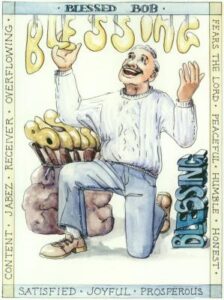
Blessed Bob